
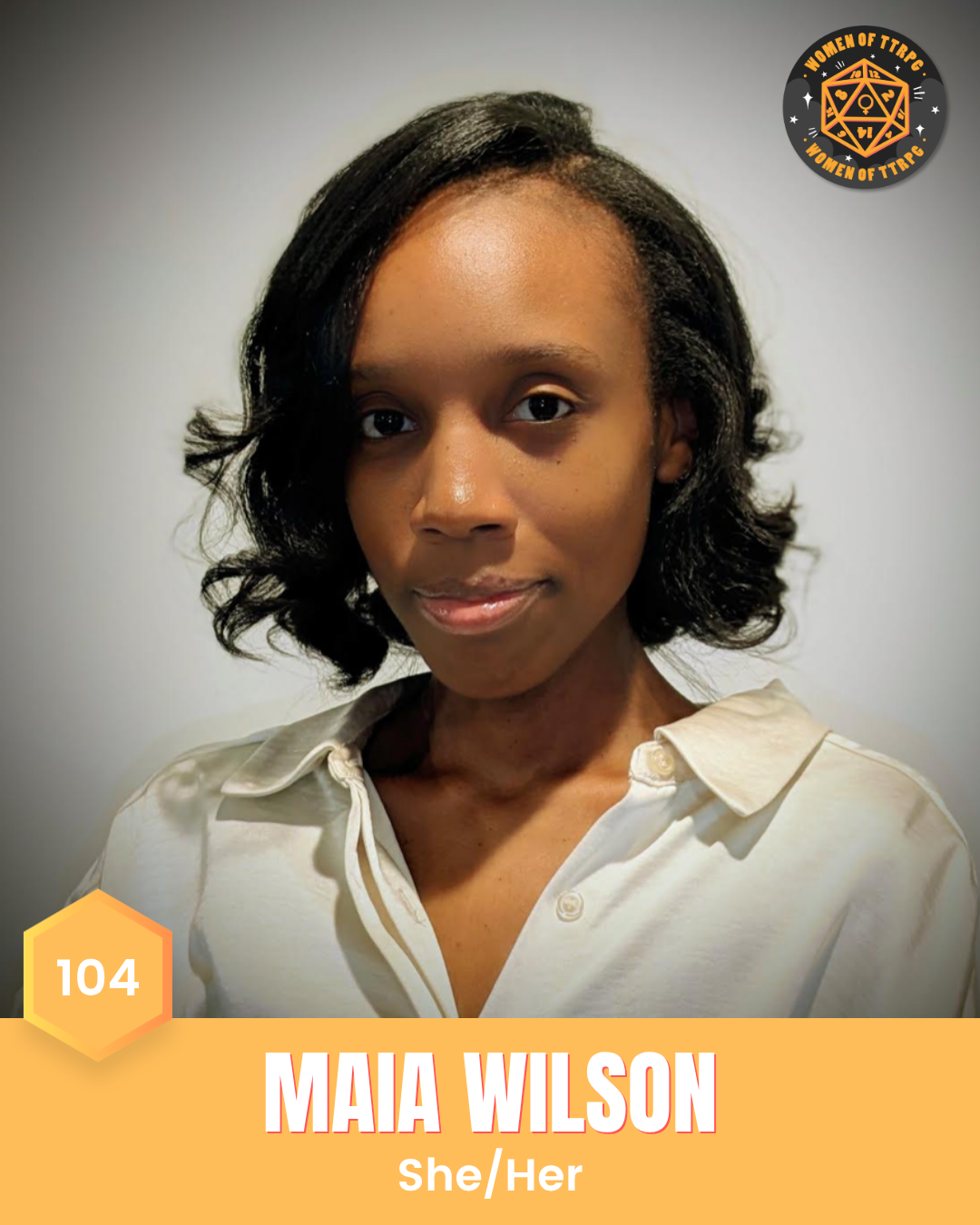
Interview – Maia Wilson
Follow Maia at:
A gritty new gun-slinging actual play is heading our way this autumn and it's fair to say we’re excited!
We spoke to its creator, Maia Wilson. Maia is a ground breaking actual play producer, working to elevate the form with a host of epic series (available now on Maia’s Game Room), and now she’s got the gritty Western in her sights.
Find out all about the upcoming The Six‑Gun Sisterhood and how Maia is bringing it to life. Maia also shares how Project Blacklight is helping new creators starting out in the TTRPG actual play space and shares some great advice for anyone starting their own actual play project. If that's you, you won’t want to miss this one!
1. Tell us all about your TTRPG origin story.
I started playing TTRPGs in March 2023, and I quickly realised that crunchy, combat focused systems like D&D, Pathfinder, and Draw Steel weren't really my style. I wanted something more narrative-driven, something that prioritised character arcs and collaborative storytelling over wargaming tactics.
So I went searching and I found games like City of Mist and other Powered by the Apocalypse systems, and everything clicked. I loved the focus on character, the shared narrative, and having more than just a binary success/failure roll. It felt like storytelling first, mechanics second – which is exactly what I was looking for.
Around that same time, a friend introduced me to actual plays. I didn't know what they were at first, but I started watching Critical Role, Dimension 20, and others, and I realised this was something I wanted to create. So since 2024, I've been producing, learning, and growing in the actual play space.
2. Congratulations on being selected for Project Blacklight! We're so excited for your winning actual play show, The Six‑Gun Sisterhood. What can you tell us about this epic new project?
Thank you so much! I'm still buzzing about it honestly.
The Six‑Gun Sisterhood is a gritty, eight‑episode Western audio drama about three Black outlaw sisters who rob a private stagecoach and steal a locked iron case. Now they're being hunted across a lethal 1885 frontier by the most powerful men in the territory and they have to decide if what's inside that case is worth the blood they're spilling to keep it.
At its heart, this is a story about sisterhood, survival, and the weight of family. The sisters are complicated, fierce, and deeply human.
We're using the Frontier Scum system, which is rules‑light and lethal and I think it's perfect for a Western! And I've built a whole homebrew setting called Sierra Blanca, a fictional 1885 territory that draws from real history while centering Black, Indigenous, and Mexican stories that have often been erased from the Western genre.
The show is a Project Blacklight production, which means we have funding, mentorship, and distribution support from BlackwaterDnD and other sponsors. We've got an incredible cast and production team and I truly believe this story is one that deserves to be told. I can't wait for people to hear it!
3. How are great initiatives like Project Blacklight helping the growing TTRPG industry?
Initiatives like Project Blacklight are exactly what the TTRPG industry needs right now. The actual play space has grown so much in recent years, but it's still incredibly hard for new creators to break in, especially those from underrepresented backgrounds.
Project Blacklight addresses that directly. The $3,500 production budget is a massive help, but the real value's in the mentorship, distribution support, and industry connections. Which has been invaluable!
What I love most is that it's designed with an artist-first mentality. You retain full ownership of your IP. BlackwaterDnD isn't taking your story, they're helping you tell it and that's rare and important. I think projects like this help the industry grow by actually opening doors for fresh voices and completely new kinds of stories. They show that there's room for more than just the same few shows and systems.
I'm just so grateful to be part of the first cohort of winners and I really hope Project Blacklight becomes a model for other networks and companies to follow.
4. With so much experience bringing amazing actual play shows to life through Maia's Game Room, what makes for a winning actual play show for you?
There's some subjectivity here, but a few things feel more like objective truths to me.
First and foremost, you need a great cast with real chemistry. If the players don't genuinely enjoy being at the table together, the audience will feel it. The best shows feel like you're eavesdropping on a group of friends who are deeply invested in the story they're telling together. It's the most subjective of the three, but I think most listeners can feel when a table genuinely enjoys being together.
Second is pacing and editing. A lot of actual plays are recorded and released raw, but I believe in editing with intention. Cutting out dead air, streamlining rules conversations, and keeping the story moving makes a huge difference in whether a listener stays engaged. A 45 minute episode that's tight and focused will always beat a 3 hour episode that drags.
And third, good audio quality is absolutely a non‑negotiable. If the sound is bad, people will stop listening and it doesn't matter how good the story is if the listener can't hear it clearly, they'll move on.
Music, sound effects, and ambience are wonderful tools, and I love using them in my own work. They add texture and atmosphere, but they're the icing on the cake and not the cake itself. A show can still be great without them. A show can't be great without good audio, solid pacing, and a cast that clicks.
5. For anyone thinking of creating their own actual play shows, what advice would you offer?
My biggest piece of advice is to practice before you go live or release anything. Record a few sessions, listen back, and see what works and what doesn't.
One thing I recommend is uploading your practice sessions to YouTube as unlisted videos. Share them with a few trusted people and ask for honest feedback. They'll notice things you and your cast might miss like pacing issues, audio problems, moments that didn't land the way you thought they would.
Treat one of those practice sessions as a dress rehearsal. Act like it's the real thing. Then go back, watch it, and take notes. You'll learn so much just by seeing it with fresh eyes.
For gear, you don't need to break the bank. Get decent mics, they don't have to be expensive, but aim for something better than a cellphone mic. That alone will make a huge difference.
And above all, be intentional. Ask yourself why you want to do this and if it's for entertainment, take it seriously. Care about your players, of course, but also care about pacing, editing, and audio quality. That shows you care about what the audience is going to get in the end – and that's what will keep them coming back.
It's going to take some work though. And if you're not willing to put in that work (if you're not going to care about the final product) then it's best to just keep the game as something private and cool for you and your friends. Not every game needs to be a show and some things are better left for the table. And hey, that's okay too.
Thank you so much to Maia for speaking to us. We’re sure you’re all just as excited as we are for The Six-Gun Sisterhood, so go give Maia’s Game Room a follow now to make sure you don’t miss a thing.
Thanks for reading and supporting Women of TTRPG!